
Category Analysis: Feline Merchandising
It’s been famously quoted by Elizabeth Peters that “the way to get on with a cat is to treat it as an equal—or even better, as the superior it knows itself to be.” And when it comes to feline merchandising trends, cats and how their pet parents take care of them, reign supreme. Premium, humanized, and sustainable products are leading across cat food, litter, and accessory categories.
To understand how these trends are reshaping the pet aisles, industry leaders weighed in. Leslie Ellis, Digital Marketing & Promotions Manager of Healthy Pet, shared how pet parents are influencing all things feline. “A major challenge that’s driving change and fresh thinking in the feline merchandising trends category is the way cat ownership is evolving—especially the rise of multi-cat households and emerging owner demographics like ‘cat dads.’ These shifts are forcing retailers and brands to rethink how they merchandise, position, and innovate products for the modern cat-owning consumer. Cat ownership is increasing rapidly, with multi-cat households growing significantly in recent years. This trend increases demand for products that handle multiple cats’ needs—including litter that controls odor better and lasts longer.”
She continued, “Products like new ökocat multi-cat litter are direct responses to these shifting needs: they offer enhanced odor control and performance tailored for homes with multiple cats. This kind of innovation reflects how brands are rethinking traditional product solutions to meet the practical demands of multi-cat households.”
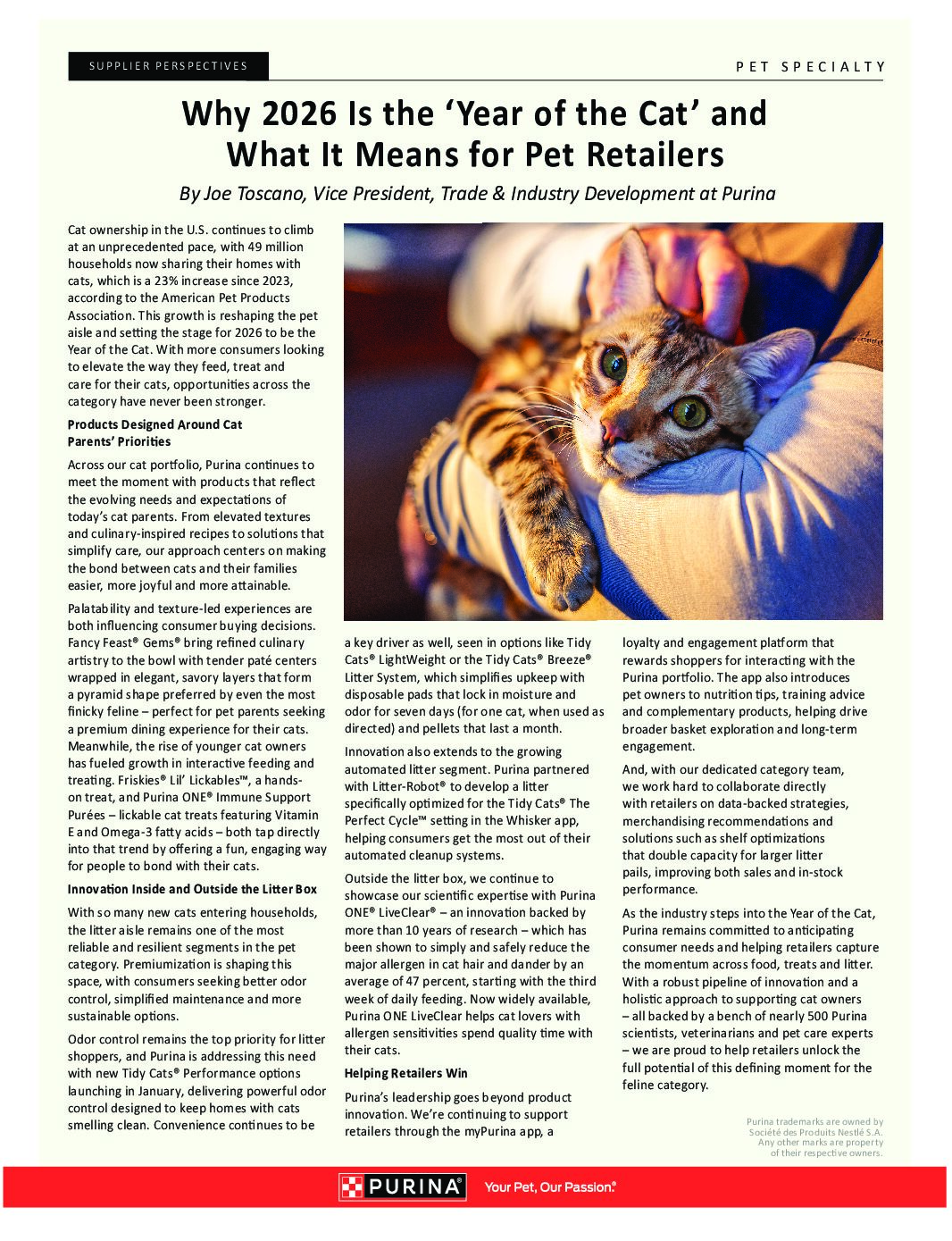
Many online media sources are reporting on the rise of the cat dad. Data shows that cat ownership among men is surging, with Millennial and Gen Z men driving a 23 percent increase in U.S. cat households. Head over to TikTok, and #CatDad content is also trending. How are dads different than cat moms? Cat dads are more focused on training and traveling, which has led to an increase in cat harness and leash sales.
This rise of the cat dad may signal something bigger for the category. The feline aisle is no longer static or predictable, and brands and retailers must rethink how they approach many things, including innovation. Innovation can no longer just be about responding to shifting needs, but it must also challenge assumptions within the category itself. “The main challenge in innovating within the feline merchandising trends category is changing long-standing beliefs about how cats play, shop, and engage, both at the retailer and consumer levels,” observed Mike Bateman, National Sales Director of Smarter Paw —which manufactures the Meowijuana brand. “For years, this category has been viewed as low in innovation and customer engagement, featuring peg hooks with similar plush toys, loose catnip, and low-margin consumables with minimal storytelling. Often, resets occurred out of routine rather than insight. While the potential is significant, industry players must stop treating cats as a slow-moving category and see them as a ripe category for engagement. Once this mindset shifts, merchandising innovation will follow, as we’ve already observed with many of our partners.”
That shift in mindset is also changing how consumers evaluate litter performance and value. “Cat parents are no longer choosing litter based on price alone. They’re looking for products that actually make life easier with better odor control, less tracking, and simpler cleanup. Brands that can tell that story clearly and show real results are the ones that will keep pet parents coming back,” Josh Wiesenfeld, CEO of Boxiecat, reported previously.
Boxiecat uses real, unprocessed clay from Wyoming with no artificial dyes or additives. Following restorative and responsible mining practice, the company puts every batch of litter through rigorous performance testing.
When it comes to Boxiecat’s top strategic focus in 2026, he shared it’s “deepening our leadership in performance litter while expanding our role as a trusted partner to both cat parents and retail partners. This includes continued innovation in solutions, strengthening vet-backed credibility, and scaling education that helps consumers understand how the right litter can improve both cat health and household life.”
Messaging about health is emerging as another key differentiator in the category, particularly at retail. “Pet parents are prioritizing their pet’s wellbeing,” concluded Mat Brost, Director of Marketing of Dr. Elsey’s. “They are reading labels, understanding health issues and are making purchase decisions based on what’s best for their pet. This is where independent retailers are able to shine. Educating consumers about common issues and the specific benefits of the products they make available is where these retailers stand out compared to big box and e-Comm. That knowledge, combined with the trusting relationships they have with their customers, makes our independent partners the key to educating pet parents.”
Beyond health and performance, sustainability continues to shape purchasing decisions.
Sustainability is where Healthy Pet is focusing on the year ahead. Ellis reported, “Healthy Pet’s top strategic focus for öko cat natural litter in 2026 centers on expanding the brand’s sustainable product lineup and distribution while reinforcing its eco-friendly value proposition—particularly through the rollout and scale-up of new formulations designed to meet evolving consumer needs. The brand continues to emphasize its sustainable, plant-based identity—using reclaimed wood and paper fibers with no harmful chemicals or synthetic additives—which resonates strongly with eco-conscious consumers. Our packaging remains aligned with environmental values (100 percent recyclable, biodegradable), helping strengthen the product’s appeal to eco-minded cat owners.”
The emotional and financial commitment behind these purchasing decisions is backed by data. According to new research, 65 percent of pet owners would make budget cuts to their own lifestyle before disrupting their pets’. The research was conducted for MetLife Pet Insurance and consisted of 2,000 dog and cat owners. The survey found that pet parents spare no expense when it comes to their furry family, splurging on high-quality food (66 percent), new toys (40 percent), and grooming sessions (24 percent).
“Millennials and Gen Z consumers are prioritizing litters with superior odor control, reduced dust and environmentally friendly benefits. This is largely due to wanting the best for their ‘fur babies’ and a clean home,” conveyed Jean Broders, Director of Marketing for World’s Best Cat Litter (WBCL). “They also prioritize health. Our Health Check-In Litter Additives are a sure way to stay on top of their cat’s health by detecting blood in their urine early. This is right on trend with what consumers are looking for. In addition, they are also looking towards tech items that will help detect and regulate their pet’s health.”
While litter remains an important need for all cat parents, innovation isn’t confined to the litter box—enrichment and play are undergoing a transformation too. An emerging trend in the cat product category is replenishable enrichment, revealed by Bateman of Smarter Paw. “Items that combine play, consumables, and sensory stimulation designed for repeat purchases. We’re observing a transition from single-use plush toys to more engaging systems such as lickables, infused chew-and-play items, silvervine mixes, scent-based toys, and interactive products that offer multiple play sessions per purchase. Cat parents are shifting from simply buying ‘a toy’ to creating an experience cycle—stimulate, reward, and repeat. Successful brands and retailers will market cats’ products less as static toy sets and more as dynamic enrichment programs featuring rotation, themes, and refills. This approach promises the strongest growth and margins.”
With this shift, brands are aligning their 2026 strategies around repeat engagement rather than one-time purchases. That’s why SmarterPaw’s main priority is to increase both turnover and basket size in the cat aisle by focusing on repeat purchase programs, rather than solely on new products. Bateman explained, “We are expanding our most successful Meowijuana formats into display-ready, replenishable assortments that are simple to set up, easy for customers to shop, and designed to encourage habitual buying. This involves offering more consumable play formats, developing stronger themed programs, and utilizing modular merchandising that allows shelf refreshes without a complete reset. Our objective is clear: to help retail partners boost cat product revenue per foot by blending innovation, education, and ready-to-implement merchandising solutions that drive conversions.”

No strategy can succeed without retailer collaboration. To reach more pet parents, many feline-focused companies are working hard to support retailers. Brost of Dr. Elsey’s reported, “One way we’ve prioritized these partnerships is by leveraging our social media and other marketing channels with targeted campaigns driving traffic to brick-and-mortar locations. We’re able to reach geographic audiences with awareness campaigns that drive pet parents to their local independent pet retailer. The benefits are amazing as we’re sending consumers to their local independent shop to purchase or get additional information while educating pet parents on our products and benefits.”
In fact, Dr. Elsey’s top strategic focus in 2026 is to expand their distribution network and increase independent pet availability. “We have an assortment of solution-based products that are now available at distributors so our independent B&M partners can expand their inventory with premium cat litter and food products.”
“Retailers want brands that simplify the shelf and drive repeat purchase, while pet parents want products that clearly solve their specific pain points,” explained Wiesenfeld of Boxiecat. “Brands that help retailers tell a clear story and help consumers quickly understand the value will stand out.”
A focus on messaging also helps retailers reach more customers. Ellis described, “Healthy Pet has sharpened its brand story around natural, sustainable pet products that appeal to health- and eco-conscious consumers. This clear mission—’Best in home. We make pets more at home, naturally’—helps differentiate the brand on-shelf and online, making it easier for retailers to communicate value, performance, and purpose to customers who are increasingly willing to pay for healthier, more sustainable options. Healthy Pet has evolved from simply making natural pet products to actively supporting retailer growth and consumer adoption by scaling distribution, clarifying its sustainability value proposition, and enhancing digital and brand marketing to meet modern pet owner expectations.”
“SmarterPaw has transitioned from being a product-centric supplier to a retail program partner that emphasizes sales speed, simplified merchandising, and consumer education,” described Bateman. “We developed Meowijuana and related lines like Kitty KaZoom with ready-to-use assortments, display-friendly programs, and refillable enrichment options that encourage repeat purchases rather than just initial trials. Currently, we assist retailers with tailored channel-specific assortments, modular display solutions, enhanced packaging communication, and trendy themed sets that simplify shopping and management for cats. Additionally, our multi-channel distribution and consumer outreach have grown, enabling more shoppers to learn about our brand before reaching the shelves, which boosts in-store pull-through and sales conversions. In essence, we’ve moved from offering individual SKUs to presenting a tested, comprehensive feline growth initiative.”
All of these behavior shifts, retailer support and innovation are happening during a time of sustained growth in cat ownership worldwide. Exact global numbers for cat ownership vary, but 2026 estimates around 650 million people worldwide live with cats, with strong growth in the U.S., where 49 million households owned cats by early 2026. This significant increase has been driven by cats’ low-maintenance nature, making them easily adaptable to urban living and busy schedules.
“As cat ownership continues to grow, cat product brands are positioned to gain from this growth,” reminded Broders of WBCL. “For years, the focus has been solely on dog products, but there is market share to capture in all things cats! We check a lot of boxes for what cat owners are looking for, with offering a premium product—innovation around health and sustainability—and making an emotional connection with our consumers. All winning attributes to have to lead the category.”
With so many feline families, an increase in premiumization, and evolving consumer expectations reshaping the category, the natural question becomes: where is innovation headed next? When it comes to litter, Wiesenfeld envisioned, “innovation is moving toward products that are smarter and more intentional—litter that does more than just absorb. That’s been core to how Boxie approaches the category, from advanced odor control to features that support better litter box habits and cleaner homes. We make it a priority to clearly explain how those innovations actually improve everyday life for cat parents.”

“The litter additive category is also growing steadily,” reported Broders of WBCL. “It allows consumers a low barrier to trial since they mix with their current litter and no unnecessary stress to their cats, since they don’t have to change their litter.” She continued, “Our strategic focus is to support our new products, especially our Poop Fighter formula. We are already the No. 1 natural and sustainable litter, so consumers for years have chosen us to capitalize on bringing an environmentally-friendly litter into their homes.”
Brost of Dr. Elsey’s previously confirmed that, “Innovation is moving toward feline-centric functionality, not cosmetic features. The biggest disruption is the continued move away from scented products toward unscented litters that reduce stress and promote proper litter box behavior. We’re also seeing increased attention to performance in automatic and robotic litter boxes, where clump strength, odor control and reliable consistency matter more than ever. The brands that win won’t be the loudest—they’ll be the ones that quietly solve real problems for cats and the people who care for them.”
Some brands are focusing on the category’s most persistent pain point. Megan Raney, Director of Marketing for Targeted PetCare, responded, “We’ve been working hard behind-the-scenes to prepare our brands for growth—you’ll see a lot of that work in 2026! We’re excited to launch sWheat Scoop Triple Action in 2026. Built from the insight that odor control is cat parents’ biggest pain point in the litter category, Triple Action focuses on eliminating odors with our Odor Guard Technology.”
The future of the category may hinge on how well brands balance performance, sustainability, and changing household dynamics. So then, what’s going to be the next big thing in the cat litter category? Ellis of Healthy Pet answered, “High-performance, purpose-built litter solutions that meet the needs of modern cat households, especially as multi-cat homes continue to rise and owners demand stronger odor control, longer-lasting litter, and easier maintenance. Innovation will focus on natural, sustainable litters that outperform traditional clay, like new offerings such as ökocat Multi-Cat, while also expanding into health-forward and tech-enabled features. At the same time, shifting demographics—like the continued growth of engaged ‘cat dads’—will push brands to modernize marketing, packaging, and merchandising to better reflect today’s cat parent.”
“The category is evolving toward products that provide multi-sensory experiences,” replied Bateman. Products that “encourage repeated engagement and offer clear behavioral benefits. This is supported by modular displays and themed sets that keep the aisle lively without requiring constant full resets. At SmarterPaw, we are not merely following this trend; we are actively shaping it. Our goal is to transform the cat toy section from a static area into a destination for repeat purchases and enrichment. This involves developing scalable programs rather than just launching new items, with merchandising and packaging crafted to drive quick conversions at the shelf.”
As cat ownership grows and expectations rise, purchasing decisions for the family feline are driven by performance, sustainability, and health. The next era of feline merchandising will belong to the brands that clearly communicate real benefits while creating meaningful emotional connections with cat parents.
Inside
Category Analysis: Feline Merchandising
Category Analysis: Freeze-Dried Merchandising
Category Analysis: Health and Wellness
Category Analysis: Interactive Dog Toys
Category Analysis: Omega-3 Supplements
Category Analysis: LID Premium Foods
Special Report: Global Pet Expo Preview
Q&A Interview with Mike Karsting, Senior Vice President of the World Pet Association